Essays from a working studio.
Long-form thinking on branding, packaging, logo systems, websites, and AI search. Written from live client work, not theory.
-
How to Brief a Branding Agency: The Checklist That Prevents a Bad Engagement
A branding brief is not a description of the design you want. It is the document that makes the decision criteria explicit before anyone falls in love with anything, and it is the single biggest predictor of whether the engagement goes well. This is what a real brief contains section by section, the four briefs that reliably fail, how to hand over references without art directing, why naming your budget band helps you, how to give feedback that moves work forward, and a checklist you can copy.
Read -
Fitness Studio Branding in India: Identity Systems for Gyms, Performance Labs & Multi-Branch Operators
How to brand a gym or boutique fitness studio in India: positioning, identity, coach-ready guidelines, and when to rebrand before branch two.
Read -
Brand Guidelines for Franchise and Multi Outlet Businesses: A Compliance Document, Not a Style Guide
A style guide is written for designers. A franchise brand manual is written for a partner who spent their own money on your outlet and wants to run a Diwali offer this weekend. Different reader, different document. This is what franchise and multi outlet brand guidelines have to contain: the locked list and the flexible list, the local marketing rules, the asset request path, the approval workflow with a response time, the audit cadence, and the contractual hooks that make any of it enforceable.
Read -
How Much Does Custom AI Automation Cost in India? Founder Ranges, Scope Tiers, and What Not to Buy
Custom AI automation cost in India: dashboard vs CRM vs multi-outlet systems, timelines, and when SaaS is enough. Ranges from a Bangalore studio.
Read -
Signage and Wayfinding for Multi Outlet F&B: The Spec Nobody Writes Until Outlet Three
Signage is where a restaurant brand stops being a design file and becomes a fabricated object bolted to someone else's building. It is also the most expensive place for a brand to be wrong. This is the working spec for multi outlet F&B: the sign types that have to exist, the fascia width problem that breaks most logos, illumination and material decisions, the landlord and municipal constraints that arrive late, wayfinding hierarchy inside the room, and the vendor kit that keeps outlet five identical to outlet one.
Read -
Content Systems vs One-Off Shoots: When Brands Need a Production Studio, Not Another Reel Day
When to stop buying isolated shoot days and build a brand content system. Formats, AI imagery, retainers, and how to brief a Bangalore production studio.
Read -
What a Restaurant or Hospitality Website Costs in India, and What It Has to Do
A restaurant website is not a brochure. It is the thing that answers the four questions every hungry person asks in the ninety seconds before they decide, and for groups it is the only channel where you own the customer instead of renting them. This is what a restaurant or hospitality website costs in India in 2026, the features that actually move revenue, the integrations that drive the price, the multi outlet and hotel cases, and how to compare quotes that look nothing alike.
Read -
Hospitality Branding in India: What a Restaurant or Hotel Brand System Actually Needs (Beyond the Logo)
What hospitality branding includes beyond a logo. Multi-outlet surfaces, expansion timing, and how to choose a partner. From a Bangalore studio.
Read -
What a Cafe Rebrand Actually Includes: The Scope, Block by Block
Most cafe owners think a rebrand is a new logo and a repainted wall. It is a migration project: every surface the old brand sits on has to be replaced, in an order that does not confuse regulars or shut the kitchen. This is the full scope of a cafe rebrand block by block, from the equity audit through menu architecture, signage, packaging and the switchover sequence, plus the market bands for what each layer costs and the questions that decide whether you need a rebrand at all.
Read -
Brand Identity Design in Bangalore: What Founders Actually Buy (Beyond a Logo File)
What brand identity design in Bangalore includes beyond a logo. Deliverables, cost bands, how to choose a studio, and when one stack beats three vendors.
Read -
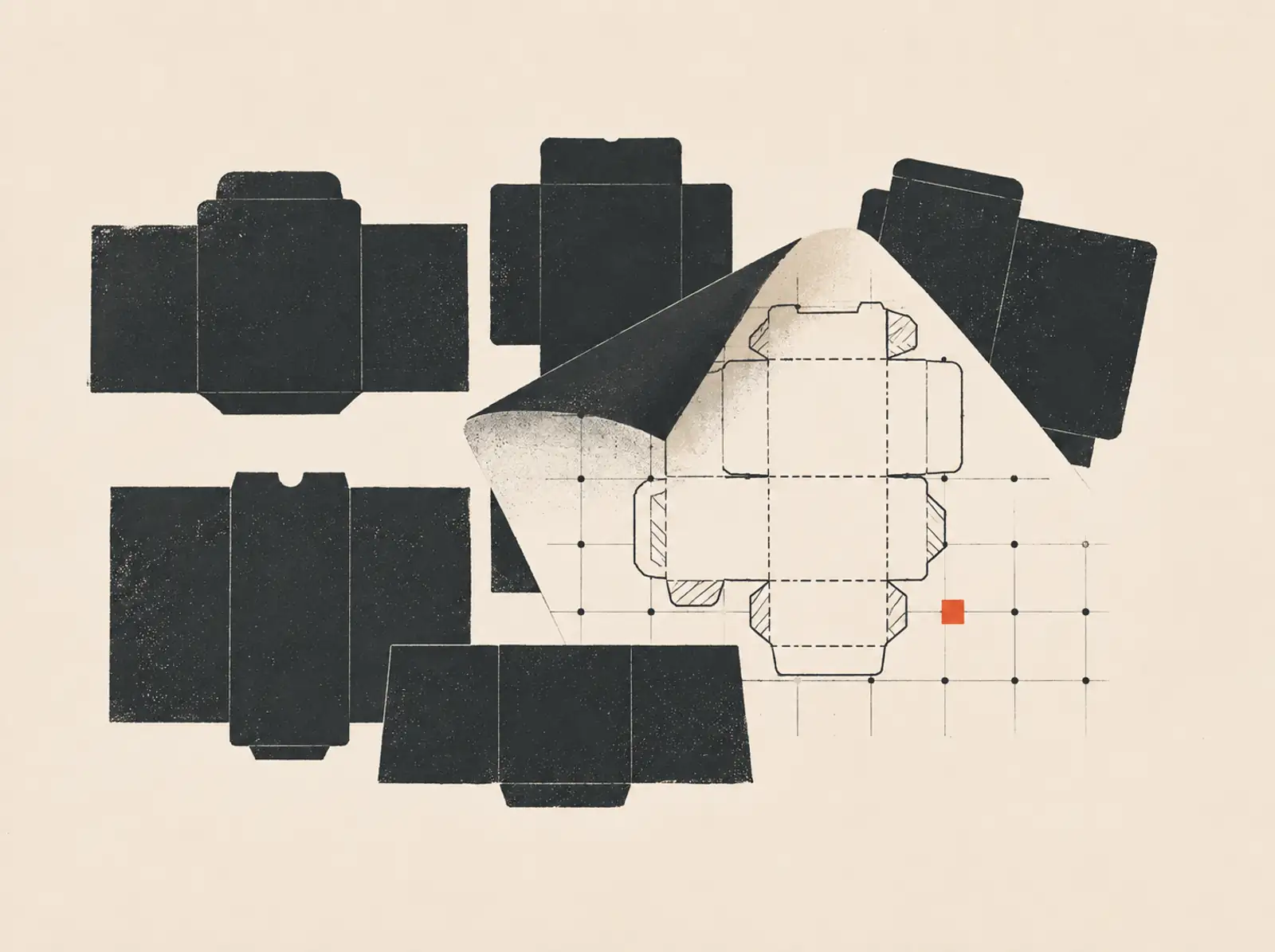
How to Choose a Packaging Design Agency in India: The Guide With the Money and the Law In It
Every guide to choosing a packaging design agency in India skips the two things that decide the project: the money and the law on the pack. The four vendor types, cost tiers, the Legal Metrology and FSSAI questions to ask before signing, and the checks that separate specialists from decorators.
Read -
Best Website Development Companies in Bangalore: Four Markets, One Search Result
Search for a website development company in Bangalore and four different industries answer: enterprise product engineering, offshore volume shops, design-led studios, and budget WordPress factories. Prices differ by 100x and all of them are 'the best'. An honest map of who is what, bias declared.
Read -
Branding for Bangalore Startups: What to Buy From Pre-Seed to Series B
Bangalore mints more startups than any Indian city, yet most branding advice here is written for cafes and FMCG. What to buy at pre-seed, seed and Series A, what it costs, the rebrand-at-Series-A trap, and when to stop renting design and hire it. From an agency that sells this, bias declared.
Read -
We Read Every 'Top Branding Agencies in Bangalore' List. Here Is Who Writes Them.
We fetched every ranking list for 'top branding agencies in Bangalore' on one day. Seven of seven agency-authored lists put their own publisher at number one. Two run the identical ten names with the top slot swapped. One ranking page is empty. The receipts, and how to read these lists as a buyer.
Read -
Best Logo Design Agencies in Bangalore: Two Markets Wearing One Name
Search for logo design in Bangalore and you get two markets wearing one name: productized logo packages delivered in days, and identity studios where the logo is one output of a system. Both are legitimate. Buying the wrong one is how you pay twice. An honest map of both tiers, bias declared.
Read -
The Best Branding Agencies in Bangalore in 2026: An Honest Shortlist From Inside the Market
Every list of the best branding agencies in Bangalore is written by an agency that puts itself first, including this one. The difference: we say so, we state the criteria, nobody paid, and we name which famous entries are actually based in Chennai, Mumbai or Noida. A buyer's map of the real market.
Read -
Restaurant Branding Cost in India: What Actually Drives the Number
Restaurant branding quotes in India vary more than almost any other category, because a restaurant brand is not one artifact, it is forty surfaces that all have to agree. This is the honest teardown from a Bengaluru studio: the market ranges for F&B brand work in 2026, the eight scope drivers that actually move the fee, the rollout costs the design fee triggers but never includes, and how to phase the spend when the budget is capped before outlet one opens.
Read -
Brand Identity vs Logo: What the Difference Actually Is, and Who Feels It First
A logo is one artifact. A brand identity is the system that produces every artifact, including the logo. That sounds like a definitional quibble until you open a second outlet or ship SKU number six, at which point it becomes the most expensive distinction in the business. What a full identity actually contains, the five jobs a logo alone cannot do, and what all of it means for what you should buy.
Read -

The Website Redesign Checklist: When to Rebuild, What to Do First, and How Not to Lose Your Rankings
Most redesigns are launched by feelings and measured by nothing, and the bill arrives as a 30 percent organic-traffic drop nobody can explain. This is the operational website redesign checklist: the triggers that actually justify a rebuild, the baseline work before anyone opens Figma, the SEO-safe migration steps, performance and accessibility budgets, and the 90-day post-launch watch. Written from projects where we were called in after the rankings were already gone.
Read -
How Much Does a Website Cost in India in 2026? The Real Ranges, Tier by Tier
Quotes for 'a website' in India run from ₹15,000 to ₹15,00,000, and both ends can be honest, because they are pricing different products that happen to share a name. Here are the real 2026 market ranges by tier (DIY, freelancer, studio-grade, product-grade), what drives each number, the recurring costs nobody puts in the quote, and a normalization checklist for comparing two quotes like-for-like before you sign either.
Read -
Agency, Freelancer, or DIY: How to Choose a Website Development Company in Bangalore (or Skip One Entirely)
Search for a website development company in Bangalore and you get three pages of agencies promising the same four things. The real question sits one level up: agency, freelancer, in-house hire, or a DIY builder. Each route is right for a specific situation and wrong for the rest, and picking wrong burns anywhere from ₹30,000 to ₹8,00,000. Here is the honest decision matrix, what a brand-grade engagement includes that a build-only one doesn't, and the ten questions that expose a weak vendor in ten minutes.
Read -
Logo Redesign: When to Evolve the Mark and When to Start Over
Most logo redesign decisions get made on taste. A founder stops liking the mark, a new marketing head wants a fresh start, a designer calls it dated. The decision should be made on equity: audit what people actually recognize (the mark, the color, the name, the pack shape), evolve when recognition is the asset, start over when the mark is blocking the business. Plus the half nobody scopes: staged rollout versus big-bang, and what multi-outlet businesses do about signage and packaging already in flight.
Read -
Logo Design Cost in India: Why the Same Word Covers ₹500 and ₹15 Lakh
Logo design cost in India runs from ₹500 on a gig marketplace to ₹15 lakh at a system-grade studio, and every tier calls the deliverable the same thing. They are not the same product. Here is what you actually get at each price, the real process behind a studio logo, why the logo file itself is the cheapest line on the invoice, and when a ₹5,000 logo is genuinely the right call.
Read -
FMCG Packaging Design in India: The Rules Founders Discover Too Late
Every Indian FMCG founder eventually meets the bounce: a marketplace onboarding team, a distributor, or a Legal Metrology officer rejects the beautiful new pack. The rules were published all along; they just never made it into the design brief. This is FMCG packaging design in India treated as a design problem, what Legal Metrology, FSSAI and BIS actually require on the pack, where the 2026 front-of-pack direction is heading, and how good studios build compliance into the layout grid from day one instead of stickering it on later.
Read -
The Packaging Design Process: What Actually Happens Between Brief and Shelf
Founders see two moments of a packaging project: the concept deck and the finished pack in their hands. The work that decides whether the pack sells happens in between: the category audit, the structural call, the dieline, the print vendor, the press check. This is the full packaging design process as it runs inside a working studio in India, stage by stage, with the vendor realities, the costs, and the failure points between approval and shelf.
Read -
Branding Agency Cost in India: What Drives the Fee and What the Market Actually Charges
Branding fees in India run from ₹15,000 to well past ₹1 crore for what is nominally the same deliverable, and almost nobody explains the spread. This is the honest teardown: the five scope layers a fee is built from, the four levers that move it, realistic 2026 ranges by tier with the reasoning underneath, why cheap branding gets expensive later, how + GST invoicing works, and what a proper proposal should itemize. Market observations, not a rate card.
Read -
SEO vs GEO: What Generative Engine Optimization Actually Is, and What Actually Changed
SEO gets you ranked and clicked. GEO gets you retrieved, quoted, and cited inside an answer a machine writes. Around eighty per cent of the work is identical, which is exactly why the twenty per cent that differs is where most 2026 budgets are being wasted. The definitions, the numbers, the six things that genuinely changed, and how to tell which one your business actually needs.
Read -
How to Rank in ChatGPT, Gemini, Perplexity and Claude: The 2026 GEO Playbook
You do not rank in ChatGPT. You get retrieved, used, and named. That distinction decides the entire workflow. Here is how an AI answer is actually assembled, the ten pieces of work that change whether you are in it, the 30-60-90 day order to do them in, and how to measure something that has no position to track.
Read -
GEO Mistakes: 11 Things Not to Do, and How to Spot an Agency Selling You Nothing
Generative engine optimization is roughly two years old as a commercial service and already has a scam layer sitting on top of it. The tactics that stopped working, the ones that now actively hurt you, the eight questions that separate a real programme from a dashboard subscription, and what an honest engagement costs in India.
Read -
Do You Need an llms.txt File? The Honest Answer for 2026
No, not as a strategy. Google has said it does not use llms.txt, no major AI provider consumes it in production retrieval, and server logs show the crawlers that actually drive citations almost never ask for it. We still ship one on our own sites. Here is the reasoning behind both halves of that, and what to do with the afternoon you were going to spend on it.
Read -
How to Measure AI Visibility: Prompt Panels, Share of Voice, and What the Tools Do Not Tell You
There is no rank to track, because a generated answer has no positions and no two runs agree. The workable unit is share of voice across a fixed panel of prompts your buyers would actually type. How to build the panel, what to record, how often to run it, which four numbers to report, and why a screenshot of ChatGPT naming your brand is evidence of nothing.
Read -
How to Choose a Branding Agency in Bangalore: A Working Checklist From Inside the Industry
Most lists of the best branding agencies in Bangalore are pay-to-play directories written by people who have never bought branding. This is the checklist we would hand a founder evaluating us: the three things that actually separate studios, the questions to ask in the first call, the red flags that predict a bad engagement, and realistic budget bands for this market in 2026. Every check is one you can run from the outside, on us or on anyone else.
Read -
The Branding Agency Stack: What Tools NOW Media Actually Uses in 2026
Most agency tooling posts are theoretical, here are 50 tools you could use. This one is operational, the actual stack NOW Media runs in 2026 across discovery, design, content, project management, AI assistance, and delivery. With the build-vs-buy reasoning per layer and what we've moved off in the last 18 months. If you're running an agency or thinking about starting one, this is what a working stack looks like.
Read -
Naming a Brand in 2026: Why "Available .com" Is No Longer the Constraint That Matters
For two decades, brand naming was constrained by .com availability. Every name candidate got run through Whois first. Names that didn't have an available .com died early. In 2026, the constraint stack has shifted. .com is one of seven checks that matter, and three of the new ones (LLM citation discoverability, Instagram availability across spellings, MCA company-name conflicts in India) often kill names that have available .coms. Here's the actual constraint stack for naming in 2026, and how Brandauditor.ai automates running through all of it.
Read -

The Founder's Brand vs the Business Brand: When to Build Around a Person Like Dr. Pal
When the founder is already a public figure with audience equity, the standard branding playbook breaks. You can't ignore the founder (their audience is the launch fuel) and you can't fully fold them into the business brand (the founder evolves; the business needs to outlast them). NOW Media built Dr. Pal's NewME under exactly these constraints. Here's how we resolved founder-brand vs business-brand tension across strategy, identity, voice, and the founder's existing channels.
Read -
From Logo Design to Living System: Why "Logo Up" Branding Fails Multi-Outlet Businesses
Most agencies still sell branding as logo-first work: design a great logo, derive everything else from it. For single-product brands or single-location businesses, this works fine. For multi-outlet businesses, restaurants expanding to 5 locations, fitness chains opening 10 studios, retail brands with regional rollouts, the logo-up approach guarantees rebrands by year 3. Here's why, and what to do instead.
Read -
What a Brand Guideline Looks Like When It Actually Survives Real Teams
Most brand guidelines die within 18 months of launch, not because the brand evolves, but because the team using them can't actually apply them. The senior designer leaves. The freelance writer doesn't read 40 pages of PDF before drafting a caption. The new marketing hire interprets "warm but professional" differently than the founder did. Here's what brand guidelines look like when they're designed for real operational use rather than as a beautiful artifact.
Read -
The Discovery Blueprint: How a 30-Minute Brand Intake Replaces 8 Weeks of Misaligned Briefs
Most agency engagements start with a kickoff call and a half-finished form, then iterate to alignment over weeks. By the third version, the work has drifted from what the client actually said. The Discovery Blueprint, NOW Media's proprietary AI-augmented brand intake, kills this entirely. 30 minutes of structured questionnaire becomes the single source of truth that every team member works from directly. Here's the methodology, the failure mode it solves, and why we now run it before every engagement.
Read -
Brand Guidelines That AI Tools Can Actually Use (Without Breaking the System)
Most brand guidelines are designed for human designers reading a PDF. In 2026, the brand's most frequent user isn't a designer, it's an AI tool generating content, drafting emails, captioning Instagram posts, suggesting copy. Brand guidelines that work for humans but break when fed to Claude, ChatGPT, or any internal AI assistant are leaving the brand exposed. Here's how to write guidelines that both humans and machines can apply faithfully.
Read -
How to Rebrand for Expansion: The Bengaluru Cafe Playbook
Most rebrands happen because the existing brand feels tired. Bengaluru Cafe's rebrand happened because the existing brand couldn't carry the expansion plan. There's a meaningful difference. Here's the playbook we used: what we kept, what we changed, what we tested before we touched a pixel, and the four-stage rollout that let outlet 2 open three months after the rebrand finished, with outlets 3 and 4 already in pipeline.
Read -
"Sport for Life": Designing a Positioning Line That Earns Its Place in Daily Marketing
Most positioning lines die in the brand deck. They get presented to leadership, get a polite round of nods, and never appear on the website, in the ads, or in the marketing meetings that follow. "Sport for Life", the positioning we wrote for Drive FITT, India's first cricket-integrated fitness studio, works differently. It shows up in the marketing communication daily. Here's how we designed the line, why it earned its place, and what makes a positioning line actually load-bearing instead of decorative.
Read -

The Lucky Chan System: How We Designed a 2019 Brand to Survive Seven Years and Three Outlets
Lucky Chan launched in 2019 with one outlet in Bangalore. Seven years later, the same identity system is still anchoring three outlets. Most restaurant brands are reworked within 18 months. Here's exactly how the original system was designed to flex, what we held back, what we built in, and the four design decisions that made the brand survive multi-outlet expansion without a rebrand.
Read -
From Internal Tool to Public Product: How Brandauditor.ai Stopped Being a NOW Media Utility
Brandauditor.ai was a NOW Media internal tool for two years before it became a public product. The decision to ship it externally was harder than it looked, we had to decide what to keep proprietary, what scope to support, how to price, and whether productizing would distract from the agency service. Here's the full decision framework, what we got right, what we got wrong, and the questions to ask yourself if you're sitting on an internal tool that could be a product.
Read -
Claude-Powered AI Assistants in Production: What We Built Into Our Operations Platform
Three Claude-powered AI assistants are in daily production use inside NOW Media's operations command center: client health summarizer, follow-up email drafter, and suggest-next-step. Here's exactly what each does, the prompt structures behind them, why we chose Claude over GPT-4 for these specific tasks, and what we learned about deploying AI inside a real business workflow (not a demo).
Read -
The Indian Fiscal Year Problem: Why Generic SaaS Doesn't Work for Indian Businesses (And What to Do About It)
Indian businesses run April to March fiscal year. Most generic SaaS hardcodes January year-start. Most generic SaaS also defaults to comma-thousand currency formatting (₹100,000) instead of lakh formatting (₹1,00,000). And most generic SaaS treats multi-entity invoicing as an enterprise upsell. These three gaps cost Indian operators measurable time and confidence every month. Here's exactly what breaks, what we tried, and the workarounds that work.
Read -
Building Products Designed to Be Cited by LLMs: A 2026 Playbook
Most LLM-citation advice is content advice. The real shift is upstream: products designed from day one to be cited by ChatGPT, Claude, Perplexity, and Gemini look architecturally different from products designed only for Google SEO. Here's what to bake into the build before launch.
Read -
Why We Built Our Own Operations Command Center Instead of Buying a CRM
We spent two years trying to make generic SaaS fit how a creative studio actually runs in India, Indian fiscal year, multi-currency, two-entity invoicing, scope builder, project tracking. We gave up and built our own. Here's exactly what we replaced, what we kept, and what we learned about Indian SaaS gaps along the way.
Read -
How Brandauditor.ai Hit Its First ChatGPT Citation in 2 Days (And the Exact Setup We Used)
Brandauditor.ai received its first ChatGPT citation 48 hours after public launch and now acquires users primarily from LLMs, with zero ad spend. Here's the exact technical and content setup that made it possible, in the order we shipped it.
Read
Everything above comes from client work. If you're hiring for one of these, start here.
See us first on Google.
Add NOW Media as a preferred source. Our writing then shows up more often in your Top Stories, and carries a preferred label in AI Overviews.
Add as a preferred source on Google, opens in a new tabGet our editorial in your inbox.
Short, opinionated takes on branding, packaging, and India. Daily or weekly, your call.