The Discovery Blueprint: How a 30-Minute Brand Intake Replaces 8 Weeks of Misaligned Briefs
Most agency engagements start with a kickoff call and a half-finished form, then iterate to alignment over weeks. By the third version, the work has drifted from what the client actually said. The Discovery Blueprint, NOW Media's proprietary AI-augmented brand intake, kills this entirely. 30 minutes of structured questionnaire becomes the single source of truth that every team member works from directly. Here's the methodology, the failure mode it solves, and why we now run it before every engagement.
Part of Branding and identity. Start with the overview: Brand Identity vs Logo: What the Difference Actually Is, and Who Feels It First.
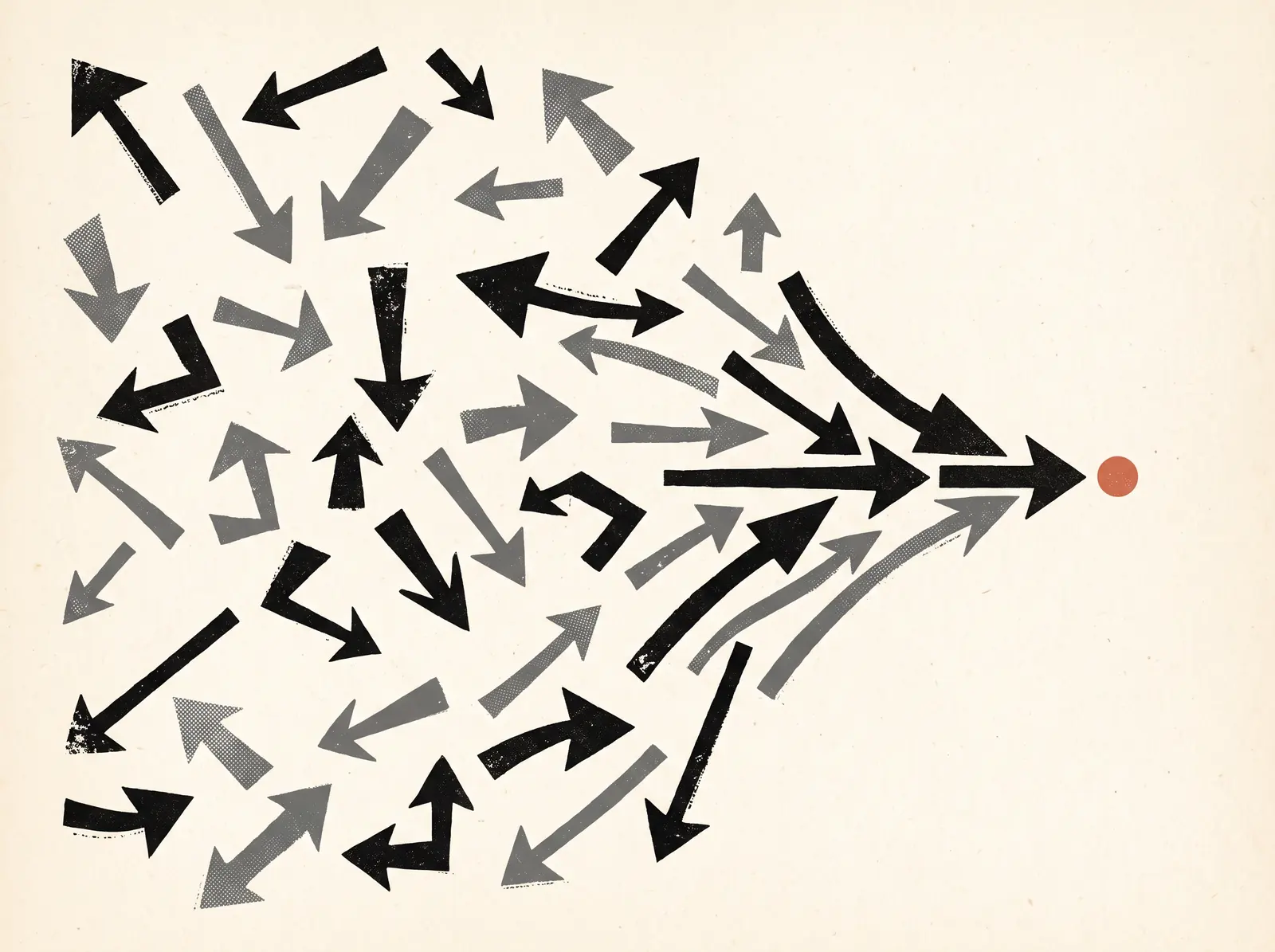
Most agency engagements start with a kickoff call and a half-finished form. The strategist takes notes. The strategist briefs the designer (their interpretation of the notes). The designer briefs the copywriter (their interpretation of the brief, which was their interpretation of the strategist's interpretation of the notes). By the third reinterpretation, the work has drifted from what the client actually said.
Two weeks of revision rounds later, the team gets back to roughly what the client said in the kickoff call, except now they've spent two weeks getting there.
This is the structural failure mode of agency-style creative engagements. It's not a quality problem. It's not a talent problem. It's an information-transfer problem: human-to-human handoffs lose fidelity, and creative engagements run on chains of three or four handoffs.
The Discovery Blueprint, NOW Media's proprietary AI-augmented brand intake, fixes this by eliminating the chain entirely. The client's answers become the source of truth that every team member works from directly. No reinterpretation. No telephone-game drift. The strategist, designer, copywriter, and engineer all read the same words the client wrote, not summaries of summaries.
Here's the methodology, the specific failure mode it solves, and what we've learned from running it across every engagement at NOW Media for the past two years.
The reinterpretation chain (what most agencies do)
Walk through a typical agency engagement, step by step:
Step 1: Kickoff call (60-90 minutes) The agency partner or strategist meets the client. They have a structured discussion. They take notes. The notes are partial, humans capture maybe 60% of what's said and 40% of what's implied. The most experienced strategists capture closer to 70%, but no one captures everything.
Step 2: Brief writeup (1-3 days) The strategist writes the brief based on their notes plus their interpretation of what the client meant. This document goes back to the client for review. Most clients skim it, agree broadly, and approve. (Few clients read briefs with the attention they read contracts. This is universal.)
Step 3: Internal handoff (a meeting plus a Slack thread) The strategist briefs the designer. They walk through the document, add color from the kickoff call ("the founder really emphasized X", "they said they didn't want Y but seemed flexible about Z"), and answer questions. The designer takes notes on the briefing of the brief.
Step 4: Design work begins The designer makes choices. Some of those choices are explicit in the brief. Some require inference. Some require asking the strategist, who answers based on memory of the kickoff call.
Step 5: Internal handoff #2 The designer hands off to the copywriter. Now the copywriter is working from: the brief (interpretation 1), the strategist's briefing notes (interpretation 2), the designer's working choices (interpretation 3, choices made based on partial information).
Step 6: First draft presented 3-4 weeks in. The client sees work. They have reactions. Some of those reactions are "this doesn't match what I said in the kickoff." Some are "this is fine, but I'd shift it." Some are "this is great but I just realized I want to add Z."
Step 7: Revisions begin Now the team is working backwards from the work to figure out what the client meant. This is the wrong direction. They should have been working forward from what the client said. But because the original information transfer was lossy, the team is now reconstructing intent from rejected output.
Most engagements stabilize around revision round 3 or 4. By that point, the team has invested 6-8 weeks getting to a place that better client-side information transfer at week 0 would have reached in week 2.
This is a structural problem. It's not solved by hiring better strategists or more empathetic designers. It's solved by changing how information transfers.
The Discovery Blueprint approach
The Discovery Blueprint replaces the kickoff call + brief writeup + reinterpretation chain with a single structured intake that the client completes themselves.
The setup:
- Adaptive questionnaire, ~120 questions in the question bank but only 30-50 surface per engagement based on the client's scope (you don't see naming questions if you're not naming; you don't see website conversion questions if you're not building a website).
- 30 minutes typical completion time (15 for tight scopes, 45 for full brand + identity + website + packaging briefs).
- Auto-saves every keystroke. Clients can complete it across multiple sittings on multiple devices.
- AI-augmented: the questionnaire branches based on previous answers (Claude is used to generate dynamic follow-up questions where useful), and AI summarizes the responses for the team before the calibration call.
- The client's verbatim answers become the brief. Not the strategist's interpretation. The actual words the client wrote.
Every team member who touches the engagement reads the original answers, not someone else's summary. The strategist reads them. The designer reads them. The copywriter reads them. The engineer reads them. When questions arise during the work, the team consults the original answers, they don't go back through the strategist.
This eliminates the reinterpretation chain entirely.
What the Discovery Blueprint actually covers
The question bank is structured into 10 thematic areas. Not all surface per engagement.
1. Business context (always surfaces)
Founder origin. Years in business. Team size. Revenue stage (rough). Funding stage. Market geography. What's currently working. What's broken.
2. Positioning and category (surfaces for brand work)
The category claim. The specific position no one else is making. Who's the target. Who's explicitly not the target. Competitors and how the client thinks about each. What would have to be true for this position to be wrong.
3. Audience psychology (surfaces for brand + website work)
Not demographics, motivation. The decision frame for the customer. What they currently use or compare against. What they say when they describe what they want vs what they actually want.
4. Visual direction (surfaces for brand + design work)
References they love, with reasons. References they explicitly don't, with reasons. The visual neighborhood they want to live in. Specific brands they admire and what specifically they admire about each.
5. Voice and tone (surfaces for brand + content work)
How the brand should sound. Specific phrases that capture the voice. Specific phrases that would be wrong. Voice modifiers across surfaces (more formal in sales, more casual on Instagram).
6. Commercial goals (always surfaces)
The conversion event the work needs to enable. The revenue or expansion outcome it's meant to support. How success will be measured. What 12 months from now looks like if the engagement worked.
7. Existing brand state (surfaces for rebrand work)
What's working in the existing brand. What's structurally broken. What has equity that shouldn't be touched.
8. Team and decisions (always surfaces)
Who's in the room. How decisions get made. Who has final approval. Who has veto. Internal politics that affect the work.
9. Timeline and constraints (always surfaces)
Real launch windows. Fiscal year alignment. Supplier lead times. Personal/founder constraints (the founder's traveling abroad weeks 4-6, the team is hiring through week 8, etc.).
10. Service-specific (surfaces based on engagement)
For websites: the single conversion event. For AI automation: workflows currently losing time. For branding: rollout surfaces and outlet count.
How it's structured for human use AND machine use
Every question is structured so the answer is useful both:
- For humans on the team: the answer reads as a complete thought that gives the team direct insight into the client's reasoning
- For AI summarization: the answer is bounded enough that AI can faithfully summarize it for the calibration call without losing fidelity
This dual-purpose structure is what makes the Blueprint work. Pure long-form questions ("tell me about your founder origin") produce great human-readable responses but break AI summarization. Pure structured questions ("rate your audience's price sensitivity 1-5") produce machine-parseable data but lose the insight that comes from open responses. The Blueprint balances both.
Five things the Discovery Blueprint surfaces that traditional briefs miss
Two years in, we've noticed five patterns that show up in Blueprint responses but rarely in traditional kickoff-call briefs:
1. The founder's actual ambition vs. their stated ambition
When you ask a founder "what's your goal for this engagement?" in a kickoff call, they tell you the polite version. They want "growth", they want "better brand recognition", they want "to scale". When you ask the same question in a structured questionnaire with no audience, they write what they actually mean: "I want to open 5 outlets in 2 years and exit at a 100Cr valuation" or "I want to be acquired by [specific competitor]" or "I want my parents to take this business seriously."
The actual ambition determines design decisions. Polite ambition produces polite work.
2. The team's internal tensions
When you ask "how do decisions get made?" in person, you get the diplomatic answer, usually some version of "we decide together". When you ask in a private questionnaire, you get the real structure: who actually signs off, who defers to whom on creative, and which of the named decision makers will go along with whatever the other one approves.
We do not quote those answers, here or anywhere. They are confidential, and the person being described is usually sitting in the next room. But knowing the real shape of it changes how an engagement is run. It tells you who has to be in the room for a presentation to mean anything, and it warns you when a sign-off is going to be reopened later by someone who was never really bought in. That almost never surfaces in a group kickoff call, because the group is exactly who it cannot be said in front of.
3. The competitors the client genuinely worries about
In a kickoff call, founders name the obvious competitors. In the Blueprint, when we ask "what brand do you worry about most" (separate question from "who are your competitors"), we get different answers. Sometimes the competitor that keeps the founder up at night isn't on the official competitor list at all.
4. The specific phrase or visual reference that captures the brand for them
We ask "is there a specific phrase, sentence, or image that captures what you want this brand to feel like, even if it's from a totally different industry?" Roughly 40% of clients respond with something genuinely useful and unexpected. A founder told us once that the brand should feel "like a good barber's hands, patient, precise, unhurried." That sentence drove half the brand decisions on that engagement.
5. The thing they wish someone had said about their previous brand work
We ask "is there feedback you wish your previous agency had given you that no one did?" Most people answer this. The answers tell us where the previous work failed and what specifically to avoid this time. This is information no kickoff call surfaces because clients don't volunteer it unprompted.
What we've learned running the Blueprint
Lesson 1: Clients write more when no one's watching
Kickoff calls are performative. Clients calibrate their answers to the room. The Discovery Blueprint is private. Clients write more openly. We routinely get 2-3x more useful content from the Blueprint than from equivalent kickoff calls.
Lesson 2: AI summarization is genuinely useful for calibration calls
After a client completes the Blueprint, Claude generates a 1-page summary for the team to read before the calibration call. The summary is faithful to the original answers (we've tested this, accuracy is high). The team arrives at the calibration call already knowing the client's business. The 60-minute call gets used for clarification, not for orientation. We get to working agreements in half the time.
Lesson 3: Some clients hate it (and we let them opt out)
About 5% of prospective clients push back on the Blueprint format. "I'd rather just have a conversation." We accommodate this, we do a traditional kickoff call instead and write up the brief in the Blueprint format afterwards. The work is the same; the information transfer is just less efficient. Some clients are more comfortable with conversational discovery, and forcing the Blueprint on them produces worse outcomes than going around it.
Lesson 4: The Blueprint surfaces engagement misfit early
Sometimes a Blueprint comes back and we realize we're not the right team. The client wants something we don't do well, or the budget doesn't match the scope they described, or the team dynamics suggest the engagement will be politically painful. We catch these in week 1 of the engagement, not week 8 of revisions. It has happened more than once that the Blueprint output led us to recommend a different agency before signing anything. That is good for everyone.
Lesson 5: The Blueprint compounds over the engagement
Every team member references it throughout the engagement. The designer pulls it up in week 4 when making a visual decision. The copywriter pulls it up in week 6 when writing taglines. The engineer pulls it up in week 8 when implementing the CMS. The Blueprint isn't a kickoff document; it's a living reference. The structured format makes it grep-able, you can find the specific answer to the specific question you have without reading the whole thing.
Why "AI-augmented" specifically
The Blueprint is AI-augmented, not AI-driven. The distinction matters:
Not AI-driven: the AI doesn't write the brief. The AI doesn't replace the strategist. The AI doesn't run the calibration call.
AI-augmented: the AI does three specific things:
- Adaptive questioning: based on the client's previous answers, the AI generates contextually appropriate follow-up questions. If the client mentions a specific competitor, the next question asks about that competitor. If the client describes a complex team structure, the follow-up surfaces the decision-making nuance.
- Summarization for team consumption: the AI generates the 1-page summary for the team to read before the calibration call. This is high-leverage because team members can read a summary 5 minutes before a meeting; reading the full Blueprint requires 30 minutes they often don't have.
- Quality-of-completion check: if the client leaves critical questions blank or gives perfunctory answers ("we want growth", "the audience is everyone"), the AI flags this and prompts for elaboration. Not in an annoying way, gently, with context for why the question matters.
The strategist still drives the methodology. The AI just removes the bottlenecks that limit how much the methodology can do.
Why this is genuinely a competitive advantage
We've watched competitors try to copy elements of the Blueprint. Some have built questionnaires. Some have built AI summarization layers. Few have built both, and almost none have integrated them into the actual engagement workflow.
The reason this is hard to copy isn't the technology, that's the easy part. It's the discipline of using the Blueprint as the source of truth across the engagement. That requires changing how strategists, designers, copywriters, and engineers work. Most agencies are organized around the strategist-as-translator role; the Blueprint eliminates that role's central function (translating client intent for the rest of the team).
Agencies built around senior strategists who pride themselves on "really understanding the client" find the Blueprint culturally threatening, because it makes the strategist's intermediation role less central. Agencies that adopt the Blueprint successfully tend to be the ones where the team genuinely wants to work from client truth rather than strategist interpretation.
This isn't a technology moat. It's an operational discipline moat. Operational discipline moats are harder to copy than technology moats, which is why we're publishing the methodology openly.
What this means for clients considering NOW Media
If you're evaluating NOW Media for a brand engagement, the Discovery Blueprint is the first step. Concretely:
- You'll start your scope at nowmedia.in/#scope. The scope builder returns an approximate cost of engagement.
- You'll then be invited to complete the Discovery Blueprint. 30 minutes typical. Auto-saves. Free. No commitment.
- A 20-minute calibration call follows. The team will have already read the AI-summarized Blueprint output before the call.
- If we're a fit, a formal proposal lands with itemized timeline + contract + payment structure.
- If we're not a fit, you'll have the Blueprint output (which belongs to you), you can share it with whichever agency you do engage. It works as a starting brief for them regardless of who builds the work.
The full methodology is documented at nowmedia.in/methodology.
FAQ
Is the Discovery Blueprint free?
Yes. Free for any prospective client. No commitment. The output belongs to you regardless of whether you proceed with NOW Media. Many clients tell us they got a sharper read of their own business from completing the Blueprint, useful even before any agency selection.
Can I just have a normal kickoff call instead?
Yes, we accommodate this. About 5% of clients prefer conversational discovery. We do a traditional kickoff call and write up the brief in the Blueprint format afterwards. The work proceeds the same way. The information transfer is just slightly less efficient.
How long is the Blueprint really?
15 minutes for tight scopes (single deliverable, narrow positioning question). 30 minutes typical. 45 minutes for full strategy + identity + website + packaging briefs. The questionnaire adapts to your scope, you don't see questions that don't matter for your engagement.
What if I don't know all the answers yet?
That's part of the value. "I don't know yet" is a valid answer to most questions. The Blueprint surfaces what hasn't been figured out yet, the gaps that would otherwise show up later as revision rounds. We treat unknowns as working items for the calibration call.
Does the AI see my answers?
For the dynamic questioning + summarization features, yes, your responses are processed by Claude. The data isn't used for any training. Responses are operational data only. If you'd prefer a non-AI-augmented Blueprint (slower, no adaptive questioning, no AI summary), we can accommodate that.
What about confidentiality?
Standard NDA applies. Blueprint responses are treated as confidential client data. If you'd like to NDA the engagement before completing the Blueprint, that's straightforward, we sign before discovery starts for sensitive engagements.
Can the Blueprint output be shared with another agency?
Yes. The output belongs to you. If you decide NOW Media isn't the right fit, the Blueprint serves as a structured brief for whichever team you do engage. Several clients have done exactly this.
How does this compare to design sprints / strategy workshops / brand audits?
Different purpose. Design sprints are about generating solutions; the Blueprint is about extracting context. Strategy workshops involve the whole team in alignment exercises; the Blueprint extracts individual founder/leadership clarity. Brand audits assess existing brand state; the Blueprint covers existing state plus forward context. The Blueprint complements these other formats; it doesn't replace them.
The Discovery Blueprint is the proprietary methodology behind every NOW Media engagement. NOW Media is a Bangalore creative studio founded in 2019 by Nithin Koshy and Divya Maben, a brand of Bleep Design Private Limited. Full methodology documentation at nowmedia.in/methodology. Start your scope.
Internal links
- Pillar: /services/branding
- Hub: /methodology
- Related: /services/website
- Related: /services/ai-automation
- Related article:
/thinking/brand-guidelines-ai-tools-can-use - Scope CTA: /#scope
- Author byline: /about#nithin-koshy
Branding and identity
What a brand identity contains, what it costs in India, and how to buy it without paying for a logo twice.
- Brand Identity vs Logo: What the Difference Actually Is, and Who Feels It First Start here
- From Logo Design to Living System: Why "Logo Up" Branding Fails Multi-Outlet Businesses
- What a Brand Guideline Looks Like When It Actually Survives Real Teams
- The Founder's Brand vs the Business Brand: When to Build Around a Person Like Dr. Pal
- Naming a Brand in 2026: Why "Available .com" Is No Longer the Constraint That Matters
- How to Choose a Branding Agency in Bangalore: A Working Checklist From Inside the Industry
- The Best Branding Agencies in Bangalore in 2026: An Honest Shortlist From Inside the Market
- Best Logo Design Agencies in Bangalore: Two Markets Wearing One Name
- We Read Every 'Top Branding Agencies in Bangalore' List. Here Is Who Writes Them.
- Branding for Bangalore Startups: What to Buy From Pre-Seed to Series B
- Branding Agency Cost in India: What Drives the Fee and What the Market Actually Charges
- Logo Design Cost in India: Why the Same Word Covers ₹500 and ₹15 Lakh
- Logo Redesign: When to Evolve the Mark and When to Start Over
- The Branding Agency Stack: What Tools NOW Media Actually Uses in 2026
- How to Brief a Branding Agency: The Checklist That Prevents a Bad Engagement