Branding for Bangalore Startups: What to Buy From Pre-Seed to Series B
Bangalore mints more startups than any Indian city, yet most branding advice here is written for cafes and FMCG. What to buy at pre-seed, seed and Series A, what it costs, the rebrand-at-Series-A trap, and when to stop renting design and hire it. From an agency that sells this, bias declared.
Part of Branding and identity. Start with the overview: Brand Identity vs Logo: What the Difference Actually Is, and Who Feels It First.
Bangalore's branding market grew up on restaurants, D2C launches and FMCG packs, and it shows in the advice. Most of what a founder reads about "branding in Bangalore" assumes you have a menu, a shelf, or a storefront. A funded startup has none of those. It has a deck, a product, a hiring page, and a clock.
This article is the stage-by-stage version we give founders in the first call: what to buy at pre-seed, what to buy at seed, what changes at Series A, what all of it costs in this market, and the one expensive mistake that repeats so reliably you can set a term sheet by it. We run a branding agency in Bangalore and sell exactly this work, so read it the way you would read any vendor's advice: the reasoning is the product, and all of it is checkable from outside.
The trap first: the Series A rebrand
The pattern we see most often in this city goes like this. At incorporation, the founders buy a logo for ₹20,000 to ₹50,000, or generate one, because there are real things to spend on. Fair. At seed, marketing hires start and the brand becomes a folder of mismatched files. By Series A, the company has a real customer base, a sales team, and an identity nobody can extend, so it buys the whole thing again, this time at ₹10 lakh and up, plus the migration cost of changing everything the first brand touched: domain, app store listings, sales decks, swag, signage if there is an office, and the recall built with early customers.
The first logo was not the mistake. Buying it with no position underneath it, and no system around it, was. You paid twice for the same layer because the first purchase was decoration, not an identity system.
The fix is not "spend big early". It is buying the right layer at the right stage.
Pre-seed: buy a position, rent everything else
At pre-seed the brand's only jobs are to be pitchable and to not embarrass you in eighteen months. That takes three things, none of which is a design system:
- A written position. One page: who it is for, what it replaces, why now, what the company refuses to do. This costs founder hours, not lakhs, and every design and copy decision afterwards gets cheaper because of it. If you engage a studio at this stage, this is the deliverable to pay for; our version is the Discovery Blueprint, and the test of anyone's version is that it produces a document sharp enough to disagree with.
- A name that clears. Trademark search, sensible domain, no pivot-hostile literalism. Naming is the one thing genuinely cheaper to get right now than to fix later; we wrote up how naming actually works in 2026.
- A deliberately minimal identity. A wordmark, one typeface, two colors, a deck template. Honest about being provisional. In this market that is ₹50,000 to ₹1.5 lakh + GST from a senior freelancer or a small studio, and it is a perfectly good buy IF the position exists in writing first.
What not to buy yet: brand guidelines, a full identity system, motion languages, mascots. You will change too much for any of it to survive.
Seed: the system starts to matter
Seed is when the brand stops being the founders' deck and starts being produced by other people: the first marketer, a content freelancer, a performance agency. The failure mode is no longer "ugly logo". It is drift: every new artifact a fresh improvisation, and the brand visibly incoherent within two quarters.
What to buy at seed:
- The core identity system. Logo behavior, type roles, color logic, layout patterns, and templates for the surfaces you actually ship weekly: product screenshots frames, social, one-pagers, the deck. In Bangalore this runs roughly ₹1.5 to 5 lakh + GST at small-studio tier, ₹5 lakh up at retainer-grade studios; the full teardown of what moves those numbers is in our pricing guide.
- Guidelines a stranger can use. Not a 90-page PDF. A short, ruthless document that lets the freelancer you hire next month produce on-brand work without a founder reviewing every artifact.
- A website that is a system, not a launch artifact. Built to be edited by non-designers, because it will be.
What still to skip: the expensive brand film, the office environmental graphics, the merch program. Those are Series A problems, and they are better problems when the system underneath them is stable.
Series A and B: rollout, hiring, and brand debt
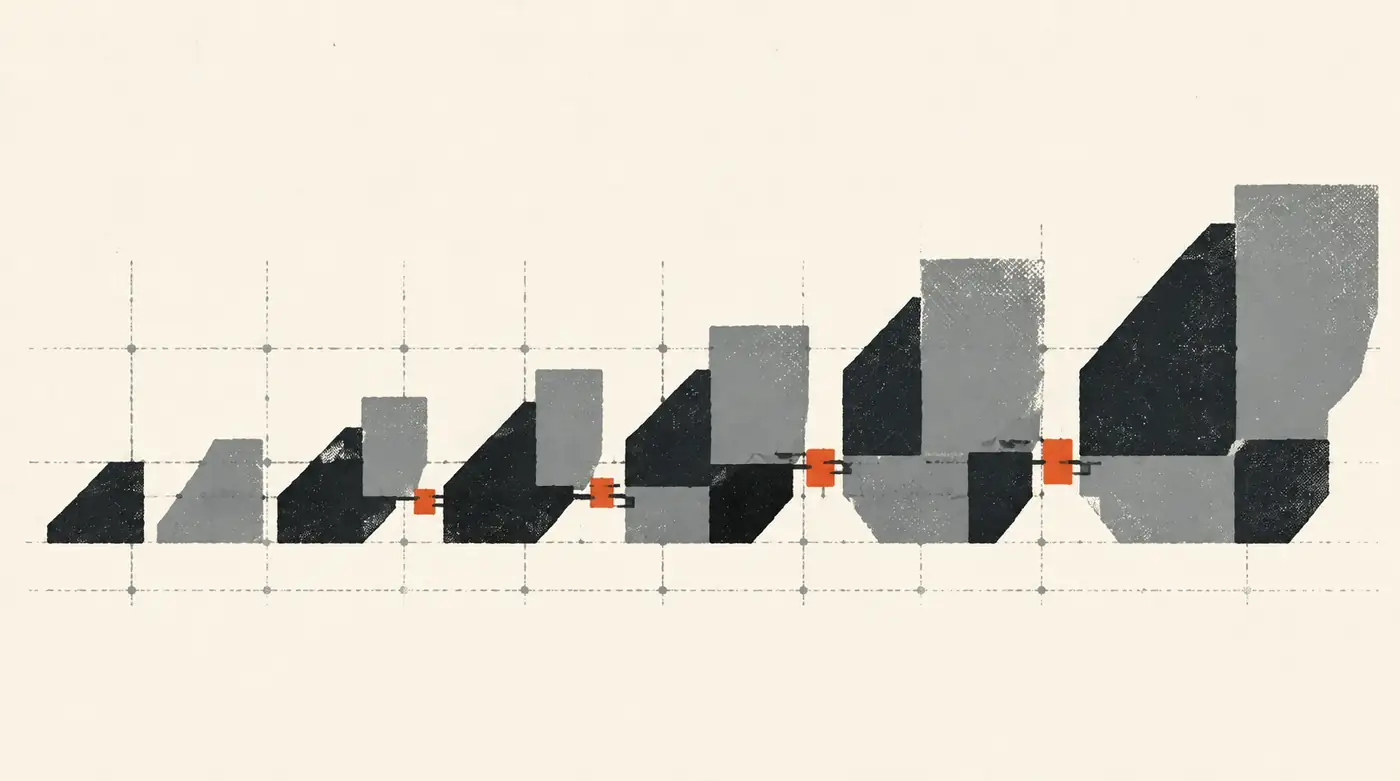
By Series A the question inverts. You are no longer buying a brand; you are operating one, and the buying decisions become organizational:
- Pay down brand debt deliberately. List every surface the old identity still lives on and migrate on a schedule, the way you would an API deprecation. The half-migrated brand, old logo in the product, new logo on the deck, reads as sloppiness to exactly the enterprise customers Series A companies start courting.
- Decide agency vs in-house honestly. The switch point is volume, not prestige. When you are producing brand artifacts daily, hire; the agency's job shifts to the system, the campaigns, and the quarterly stress-tests, not the daily output. A studio that resists this conversation is selling you retainer hours, not brand health.
- Buy strategy again, once. The position written at pre-seed was for a product. At Series A you are positioning a company: employer brand, category narrative, sometimes a rename if the pivot demands it. This is the stage where the ₹5 to 15 lakh + GST retainer-grade engagement earns its fee, because the cost of a wrong position is now measured in sales cycles, not design revisions.
Choosing who to work with
Everything in our checklist for choosing a branding agency in Bangalore applies, with one startup-specific filter added: ask to see work that shipped inside a product company's cadence. An agency used to restaurant timelines will be surprised by yours. Ask who does the work after the pitch, ask what the strategy phase produces in writing, and ask how the system holds up when your own team, not theirs, produces week-to-week.
The city's serious studios each have a lane, and startups are underserved in most of them: the famous studios here skew consumer and F&B, the packaging specialists want FMCG, and the B2B boutiques want later-stage. We keep an honest map of who is best for what, including where we think someone else fits you better.
FAQ
How much should a startup spend on branding in Bangalore?
By stage, + GST: pre-seed ₹50,000 to ₹1.5 lakh for a position, a cleared name and a minimal identity. Seed ₹1.5 to 5 lakh for the core system and usable guidelines at small-studio tier, more at retainer-grade studios. Series A ₹5 to 15 lakh when repositioning and rolling out properly. Spending a stage early wastes money; spending a stage late costs more than money.
Should we just generate a logo and move on?
At pre-seed, a generated or cheap logo is defensible IF the written position and a cleared name exist underneath it. What is not defensible at any stage is skipping the position, because every asset made without one is a guess you will pay to remake.
When should a startup rebrand?
When the position changed, not when a new marketing lead wants a legacy. Pivots, renames forced by trademark or expansion, and consolidation after acquisitions are real reasons. "The logo feels dated" eighteen months in is usually the missing-system problem wearing a design costume.
Agency, freelancer, or in-house for a startup?
Pre-seed: senior freelancer plus founder-written strategy. Seed: a studio for the system, freelancers for output. Series A onward: in-house for daily volume, a studio for strategy and the system's evolution. The wrong answer at every stage is a retainer for unspecified "design support" with no owned system underneath it.
Branding and identity
What a brand identity contains, what it costs in India, and how to buy it without paying for a logo twice.
- Brand Identity vs Logo: What the Difference Actually Is, and Who Feels It First Start here
- From Logo Design to Living System: Why "Logo Up" Branding Fails Multi-Outlet Businesses
- What a Brand Guideline Looks Like When It Actually Survives Real Teams
- The Discovery Blueprint: How a 30-Minute Brand Intake Replaces 8 Weeks of Misaligned Briefs
- The Founder's Brand vs the Business Brand: When to Build Around a Person Like Dr. Pal
- Naming a Brand in 2026: Why "Available .com" Is No Longer the Constraint That Matters
- How to Choose a Branding Agency in Bangalore: A Working Checklist From Inside the Industry
- The Best Branding Agencies in Bangalore in 2026: An Honest Shortlist From Inside the Market
- Best Logo Design Agencies in Bangalore: Two Markets Wearing One Name
- We Read Every 'Top Branding Agencies in Bangalore' List. Here Is Who Writes Them.
- Branding Agency Cost in India: What Drives the Fee and What the Market Actually Charges
- Logo Design Cost in India: Why the Same Word Covers ₹500 and ₹15 Lakh
- Logo Redesign: When to Evolve the Mark and When to Start Over
- The Branding Agency Stack: What Tools NOW Media Actually Uses in 2026